Years of My
Splendid Life
Excerpt · Book to be published in 2027

Journey North
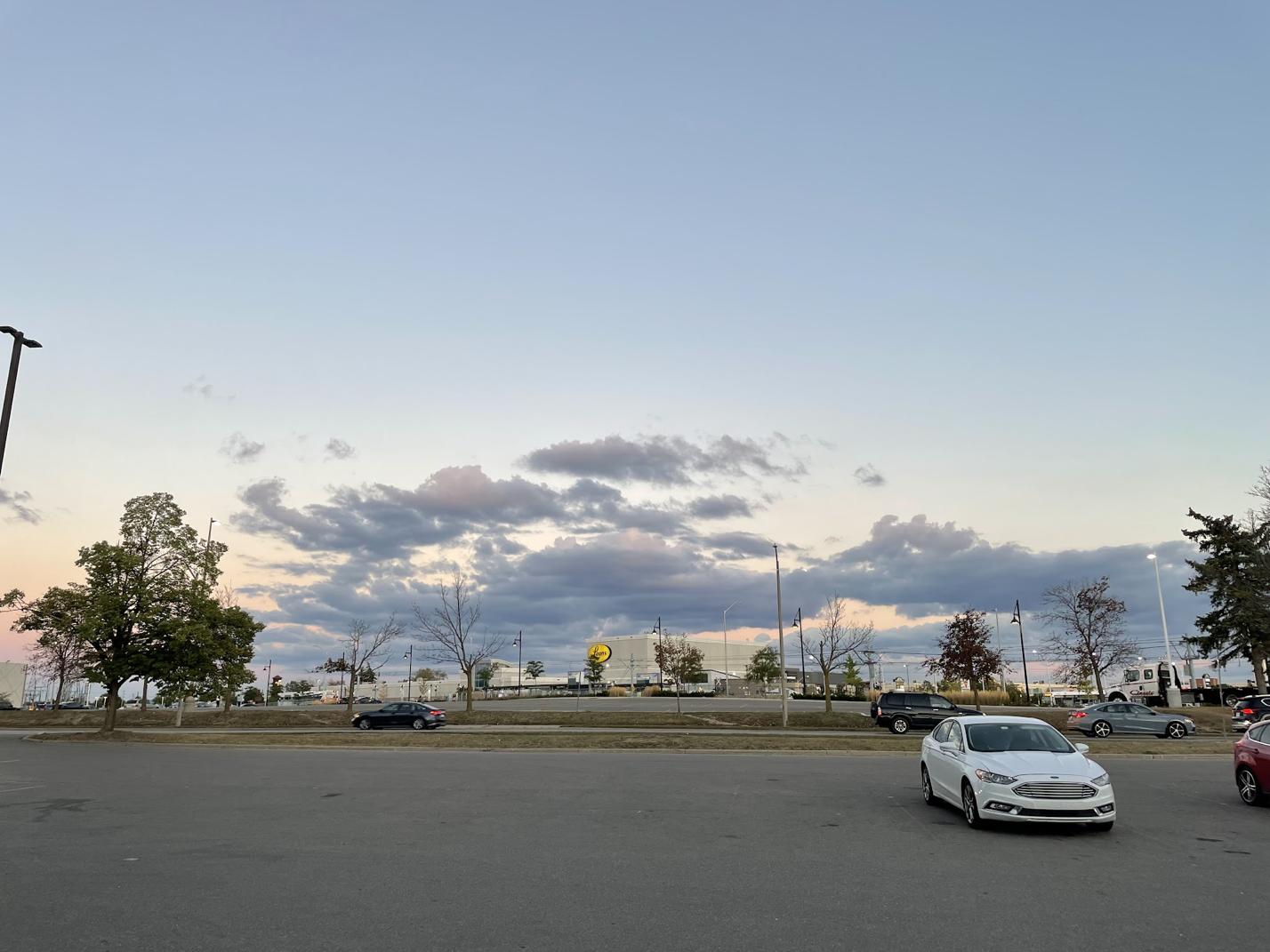
After six hours of driving, I was standing in a strip mall in the heartland of Ontario, on the outskirts of Waterloo region. It was past dinner time; the sun had already set, but a pale teal band of twilight lingered in the east, reluctant to fade. In the distance stood sparse power lines, farmland, and low industrial complexes—clean, orderly, and marked by a distinctly Canadian attention to shared spaces. Over the next few years of traveling between the United States and Canada, this vast Ontario landscape, and the culture it brews, would continue to give me perspective.
On this trip, I was heading to the University of Waterloo, meeting with my PhD advisor for the first time in person. I understood it then, and I see it more clearly now after seeing many talented new students, that I was extremely underqualified to do what I signed up to do. As a field of study that emphasizes rigor and formalism, I wasn’t yet able to read and understand the technical presentation used in the field. I had never taken an introductory course in this area. I had, in fact, taken a course during college and dropped out after two weeks, because I couldn’t focus during the lecture. The math was so simple and obvious and I lost grip of what it’s all about, and I couldn’t do homework because I didn’t know what was going on. Still, years after dropping that course, and at the dawn of my PhD years, I have become inexplicably drawn to the mythical nature of this subject, with its esoteric symbols and styles of presentation. You could also say that I was driven by regret. But more concretely, I was rebellious. Years of working in industry had gotten me frustrated to see people writing programs without really understanding, and I was sick to be one of them. I yearned for clarity, a degree of certainty, and to have a sanity of my own. And I was told, in my subconsciousness, that the study of programming language would offer me just that.
I dreamed of PhD life as having collegial labmates drinking exquisite coffees in the mornings and artisan craft beers on Friday nights, at least that was what I learnt from a Podcast about PhD lives. Yet, it turned out that I was the only person who drinks coffee in the lab, and I drink it out of a Keurig. More damagingly, I became intolerant to alcohol after getting Covid, so over the years of my PhD life, I only had a handful of beers at Grad House after someone’s defense. In retrospect, the omen of a not-so-dreamy PhD was already present at the day I met Yizhou, my future PhD supervisor. Ten minutes before our scheduled meeting, I texted him
“I am sitting at a picnic table under a big tree in front of DC. It’s good weather, can we meet here?”
He texted me, 10 minutes later, saying “I’m in my office”.
And that’s where I met him.
Yizhou is a calm, scholarly figure, and he speaks with a level of precision and careful choice of words that matches his style of writing. He is a very private person. Private in life, to the point that we students never knew what he was up to besides working on specific projects; private in temperament, in that from the outside he always emanated a calm happiness and a sense of deep fulfillment. He seldom let himself laugh, but he can be constantly amused with a whimsical smile. His sense of humor emerged through deliberate phrasing and understated delivery, giving him a distinctive role in group conversations: the one who landed the punchlines.
Anyone who has interacted with Yizhou would be familiar with the long silence he’s seemingly comfortable sustaining in a conversation. Multiple people had reported that this sends a chill up their spine when you are the only two people in the room. I experienced this silence firsthand on that first visit, which made me squeeze my brain to find topics to continue the conversation. But over the years I’ve learned to appreciate the silence. There is a sincere respect and a mutual scholarly understanding in the space he created for the other party. It is in this silence that we together carried out some deep thinking in his office. He might go back to his chair and start checking emails, but he is not going to interrupt or dictate where the thinking needs to go. On multiple occasions, it was only when his cell phone rang multiple times and I had to ask him if he needed to go, when he said “yes, I need to go in 5 minutes”. So many intellectual sparks happened in that room. When my eyes move away from the whiteboard and look through the window, I can see dark night, I can see splendid spring sunshine, I see blizzards and drowsy summer rains.
First Year
The first year of PhD was a clueless one. I had a hard time understanding formalisms and how to write them. If I were learning a new programming language, I would write programs and run them and get a gist of how it works, but I couldn’t run formalism. I didn’t know what I am allowed and not allowed to do when expressing ideas using logical inference rules; I found meta-variables to be mysterious. Because there were no senior members in the lab to help me, the only time I could learn things was during the late night Zoom meetings with Yizhou. I pretended that I understood what I was doing and scribbled the Greeks on my iPad, and Yizhou would go back and forth in correcting me. Sometimes he would be satisfied with an humongous inference rule with countless contexts and meta-variables, which to me were complete garbage that was not worth giving a second look. Oftentimes our meeting ran late into the night and our conversation gradually faded and my brain started to fog, and I felt sorry for both of us wasting our time.
Like almost all PhD students, the idea of quitting had always lingered in my mind. I was fortunate to have a safety net that I mentally cling to: my boss at my previous company had offered me a position before I moved north, and I was sure I would still have that had I chosen to go back. In fact, I was still working for them as a contractor during the first year, doing research about their software systems. But I eventually chose to not renew the contract to focus on my research; I didn’t want it to be seen as a distraction.
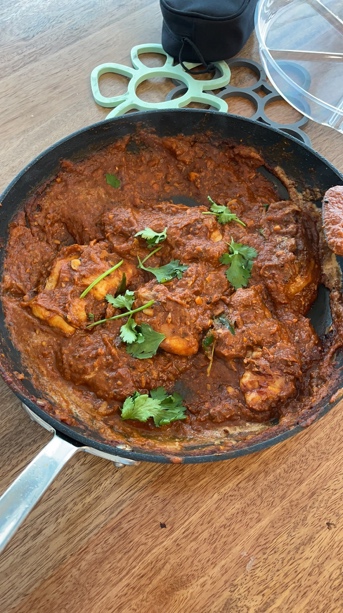
My fiancee Jia, who moved north with me and worked at a local tech company, kept me grounded during these years. We would explore the buzzling community of diverse populations. We got green coffee beans from an Ethiopian grocery store and roasted them on a pan at home; we bought fish at a local seafood store and made sashimi; I pickled radishes bought from the farmer’s market; and I made garam masala using raw spices following an Indian cook book borrowed from the local library. The curry chicken I made using my own garam masala was generously enjoyed by Jia; me, however, found them distasteful and could only eat a bite.
On the first week of us moving into the apartment, a new build with paint still wet, we met in the elevator a young and lively girl going to the same floor. With the fresh excitement of being in a new place, we invited her to our place for a beer, which she said she hadn’t had for over a year. Over the dinner table, we learnt that her name is Ohla. She left the war-torn Ukraine in the year prior, and had been moving around in temporary housing in the area; and she worked at the same company as Jia! Ohla is an avid traveller and a frenetic story teller, and her Instagram stories have since been my favorites. In the next few months, we got to know Ohla’s boyfriend Emrick, a tall, courteous French with an abundance of dry and satirical humor, a style that I learnt to pick out from French characters from TV and films. They are the funnest and cutest couple, and Jia and I had the honor to have them in our wedding in China early this year.
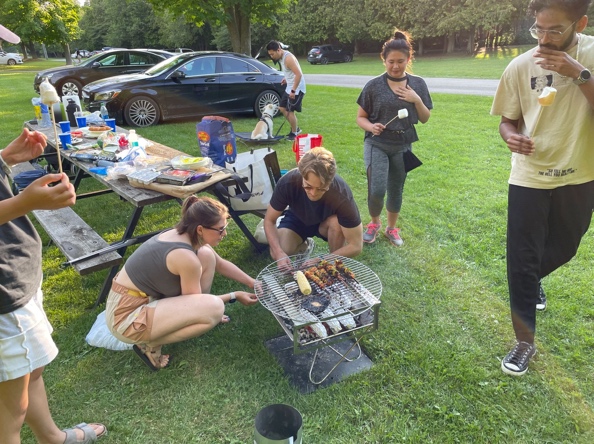
On a coffee shop trip organized by the apartment I befriended Sai. Witty, hardworking and extremely open-minded, every time I meet him he is interested in new things. Vanessa and William live in another corner unit on our floor. They are the kindest people. Vanessa once sent us some of her homemade Filipino dishes, so delicious that prompted Jia to learn to imitate the next day. In this building, the seven of us, young and carefree, loving and sincere, spent time playing boardgames, barbecuing and going out for picnics. These might be the pinnacle moments of my 20s.
First Paper
The summer of my first year passed, and I missed conference paper deadlines one after another. The week after a missed deadline, I would come to the meeting with Yizhou, business as usual, and he wouldn’t say a word about it. One day, at the start of the fall term, an undergraduate student named August joined our meeting. Tall and slender, he spoke with a reserved and diplomatic tone
“These projects all sound interesting. I think I can work on any of them.”
“You can work with me.” I said.
That is how August joined the lab, and will stay here for a long time.
August is not the first undergraduate I worked with. When I just started PhD, Yizhou introduced me to an undergraduate student from Zhejiang University who cold-emailed him asking for research work. I could barely stay afloat myself at that time, not to say mentor another student. I remember there’s one time when I asked him for help to understand a concept in a paper; he is a lot smarter than I am. He helped me understand the mechanics of the idea, but we couldn’t grasp the “why” and “how”. We were both left deeply unsatisfied.
But this time was different. I had been on this project for a year, and had been coding up some proof-of-concept compiler backend in the summer. I thoroughly enjoyed the feeling of being locked up in a dark, air-conditioned den, with blazing hot summer sun outside the blinded window; strike up a GDB session and step over lines of assembly, watching the register value blinker on the screen. Years of doing low-level hacking had buried in me the conviction that no matter how bizarre the program behaves, I can always dig up an explanation. Maybe not on the same day, but certainly the next. In fact, the more strange a phenomenon is, the more precious the final resolution becomes to me. Near the end of my PhD comes agentic AI programming which is rapidly turning the craft of coding and debugging into relics of the past, and I can no longer feel the thrill when AI explains to me an unbelievably complicated chain of reaction that culminates into a subtle abnormality. I nod, appreciating the mechanical beauty of it all. But the honor is all yours, my AI friend, who doesn’t even know the magnificence of the feat it just accomplished. These days in the lab, we brag about what AI has been able to do for us. But beneath every conversion forebodes a deep, hollow sense of sorrow, that couldn’t be filled with anything that we know yet. We are the last generation, but also the first.
Of course, when August joined us, the mood was very different. I’ve finished prototyping and the results looked promising. August was tasked with turning the prototype compiler into a real one with a usable front end. Diligent as he was, he finished it with a speed that I couldn’t do myself. Finally I could see the light at the other side of the tunnel, except there was still a road blocker: I couldn’t come up with a sound type system. Building a compiler that compiles to the typed assembly has been the goal of this project since the beginning, but I was still not making progress towards that end.
Remember that huge inference rule that Yizhou and I conjured up a year ago? The complexity might be inherent to the problem. Assembly is such a low-level and expressive language, that taming it with a type system while retaining its expressivity is difficult. Yet, that is a conclusion I am drawing today; at the time, my vision was far more clouded. Edward, a senior PhD student in the same lab, suggested to me to look up a line of work that seems to target the exact issue I was facing. I gave them a read, but was quickly tangled up in a sea of abstract formalism, which made me conclude that it would require too much effort to find anything useful, not to say to adopt in our work.
Until I can confidently say that I’ve surveyed all relevant literature, I’ll always live under the shadow of insecurity – that was how I felt before I had my first paper published. I was like a new-born baby who hasn’t learnt to control the muscles, and doesn’t even know what kind of muscles I have. What if there were legs that I couldn’t see or feel, but that was how everyone else walked, with four legs? Then, learning to walk with two legs would be a waste of time, and even worse, a source of humiliation.
Another conference deadline was coming up on the horizon. This time we were in serious business. The crew had expanded to include me, Yizhou, August and Edward. One month before the deadline, after I had once again explained the difficulties in designing the type system, Yizhou declared, to my surprise,
“We should drop the type system.”
Silence. The thorn that had been lodged in my mind for months – gone, just like that.
We still need a simulation proof to serve as a theoretical result, but I was so ready to move on from the high-minded type system design work. Simulation proof, on the other hand, is the kind of down-to-earth labour that better suited my aesthetics and abilities. I could hear the proof machinery cling-clang as I step through the math, and I could feel the gear physically stuck when it didn’t work out. Like all proof work in our field, the process involves simultaneously adjusting the subject under proof and the proof itself, until they work out together. In my case, it involves adjusting the definitions of two languages until I can establish a connection between them, like threading a yarn through two needles simultaneously. It was delicate work, but now that I was more fluent in the language of formalism, the work felt more like play.
Yizhou proposed to anchor the narrative of our paper to a particular bottleneck that a prior work exhibits, and consequently, an entire introduction section is dedicated to discuss the bottleneck. I was ambivalent about paying so much attention to a problem that seemed accidental. I said,
“I want readers 100 years from now on to still read the paper and get a wholesome story. I don’t want to anchor the paper to a particular time in history and quickly become unrelatable.”
But the story charged on, and I instead turned to focus on the technical part of the paper; my responsibility.
When reviews came back, they were overwhelmingly positive. However, that is actually not how I remembered them; I double checked the scores today and had to marvel how wrong memories can be. I had a pretty low opinion of the paper myself at the time. The technique presented in the paper was so simple and I bet any undergraduates, when given the problem, will do it that way and proclaim it lame. I think the reviewers gave good scores not because they were impressed, but because they were satisfied with the quality of the work. As one reviewer put it,
“I believe that the paper makes good contributions to formalise the compilation scheme…, which will be useful for other systems…”
Then, before we submitted the paper camera-ready, I again nudged Yizhou to agree to rewire the story and stop being fixated on the idiosyncrasy of the prior work. And he said,
“I think the story worked for the reviewers. I would keep it that way.”
Yizhou’s pragmatism and his sharp instinct for reviewer psychology are the keystone of how the lab keeps pushing out high-quality work to the finish line, which in turn keeps the creative energy flowing. But he is also lucidly aware of the harm built into the publish-or-perish paradigm of academia, and is resigned to being judged by people who do bean-counting. Even so, his research and writing display a spirit of playfulness—partly out of rebellion, and partly from a deep command of the game. That is the style he carries through the entire process of publication, and it gives real assurance to students who are still figuring out the shape of the monster.
First paper, done.
Wisdom
One thing that I’ve been wanting to do, but kept delaying because the paper kept constipating, was to ask for feedback from Yizhou. I delayed because I didn’t want to be simply told to work harder; I wanted the deep wisdom that once I incorporated into my daily practice, would make me into a great scientist. Receiving and giving feedback is a very common practice in industry, but is not a standard in grad school, so one day in Yizhou’s office, I asked him,
“How can I be better?”
Smart though like Yizhou, this seemed to be an extremely hard question.
“Read more papers. Read broadly and work hard.”
Said Yizhou after thinking for a long time. To my dismay, he didn’t offer life-changing advice for me as a person. I pushed for him to say a little bit more, but he only told me “you are doing great”.
A year later, after I had my second paper published. I asked for feedbacks again, this time, I chose a more specific question,
“How can I be successful like you?”
To which Yizhou said, “You are already more successful than me at that age…”, followed up by the normal cliche of “more reading, writing and thinking”.
Though I didn’t succeed at getting personalized feedback from Yizhou, I believe he always has deep thoughts about research and life in his mind. It was just unfortunate that we didn’t have the occasions to bring them forward. With me being an early year PhD who is still figuring out grad school, and him being a young scientist who’s still securing his position in the community, our meetings were brisk, professional and down-to-earth, and we both didn’t have the mood or capacity to indulge into high-minded conversation about research and life.
That being said, I got a truly remarkable piece of advice from Yizhou in my third year. It was at dusk during a two-day lab retreat, when we were sitting at a table in the balcony. The month of August left us with a whopping summer day of heat, but we were now accompanied by the chirping crickets and flickering light bulbs. After a round of fine food and drinks, the students asked Yizhou for advice on how to do good research. He came prepared, and with the right atmosphere, he carried on with his rare preach,
“Work on things that you find important personally. Find problems that you care about deeply.”
I was absolutely stunned. It was the first time I heard the idea of bringing oneself into science. The scientific rigor can be compatible with human desire, and they should be? For so long I’ve been absentminded about the research I was doing, and for the first time I was given the permission to feel them. I was taken back 10 years ago, to the time I read Rainer Rilke’s Letters to a Young Poet. The lightstrike Rilke’s word left on me was invigorated that day,
“There is only one thing you should do. Go into yourself. Find out the reason that commands you to write; see whether it has spread its roots into the very depths of your heart.”
I see an infinitude of possibilities.